

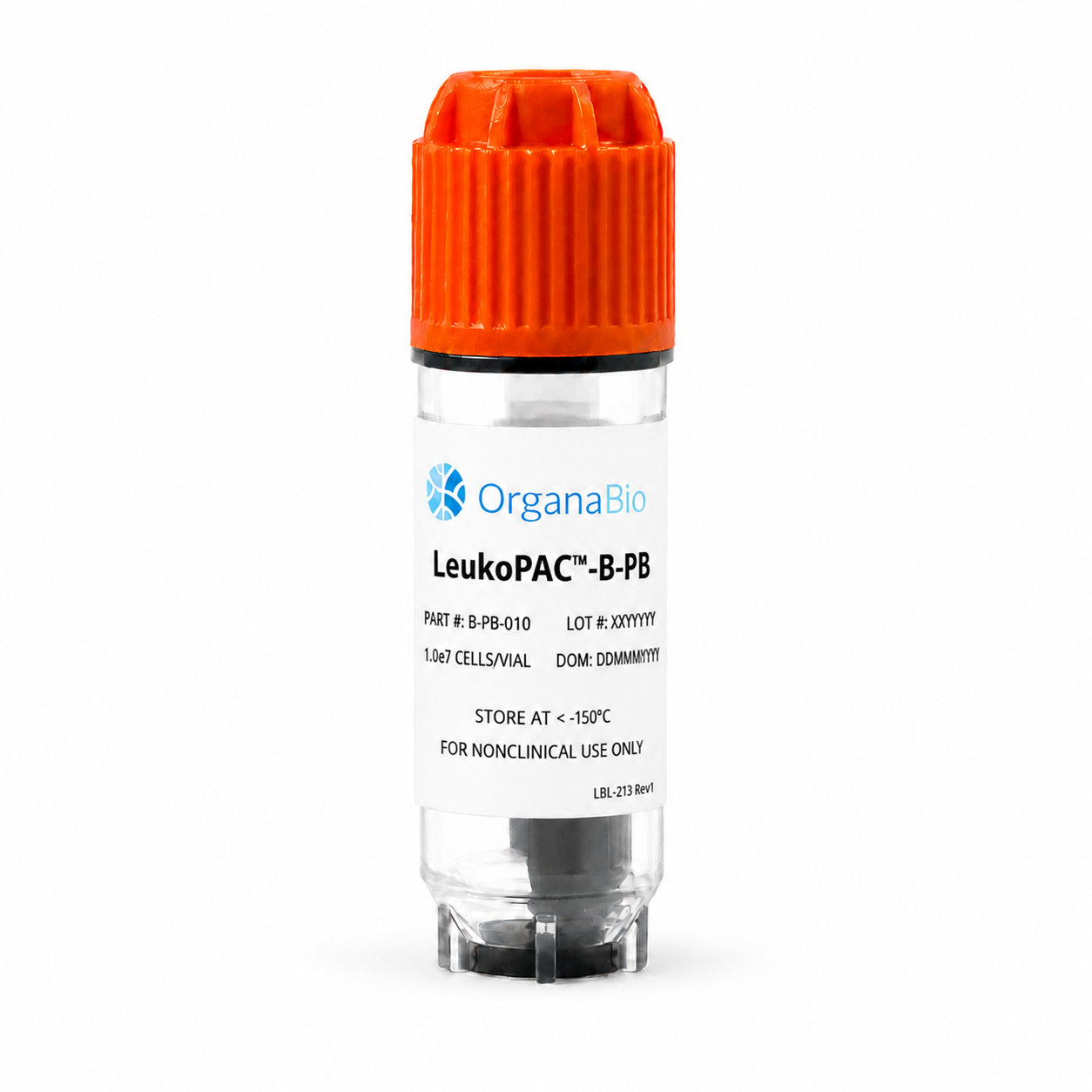
Description
B cells isolated from peripheral blood leukopaks via CD19+ immunomagnetic enrichment. Sourced from OrganaBio’s over 50,000 donors; eligible donors can be scheduled for repeat collections with 14-marker infectious disease screening and NGS HLA typing across HLA-A, B, C, DR, DQ, DP. Available as RUO and cGMP from the same donor pool under one quality system, so programs moving from preclinical to clinical do not requalify donors. Best fit: B-cell biology research, antibody-mediated cell therapy programs, and B-cell-targeted CGT preclinical work.
LeukoPAC-B-PB – Cryopreserved Human CD19+ B Cells (Adult Peripheral Blood)
LeukoPAC-B-PB delivers cryopreserved human CD19+ B cells isolated from adult peripheral blood leukopaks via negative selection. Negative selection depletes non-B cells and leaves B cells untouched, preserving native CD19 and other surface markers without crosslinking — critical for functional receptor studies, signaling assays, and any work where native biology matters.
Applications
OrganaBio CD19+ B cells are used to isolate and sequence B cell receptors and generate monoclonal antibodies, evaluate humoral immune responses and memory B cell formation, provide normal B cell controls for B-cell lymphoma, CLL, and multiple myeloma drug development, investigate B cell-mediated autoimmunity and BAFF signaling, serve as high-purity CD19+ targets for anti-CD19 CAR-T cytotoxicity and co-culture killing assays, and profile naive, memory, transitional, and plasmablast subsets with frequencies reported on every documentation.
Donor Program
Cells are isolated from OrganaBio’s recallable donor program of over 50,000 donors. Same-donor repeat collections support longitudinal studies, process development with consistent starting material, and matched donor panels across product lines.
Quality and Documentation
Donors are screened under IRB-approved consent and FDA 21 CFR 1271 donor eligibility criteria. Each lot ships with documentation including donor screening, B cell subset frequencies, immunophenotyping by flow cytometry, HLA Class I and II typing, and cryopreservation details. FDA Registered. cGMP available.
Configurations
Available cryopreserved at 5×10⁶ and 10×10⁶ cells per vial. Custom vialing, custom donor criteria, and fresh format are available on request. Cells are for preclinical research use only and not for use in humans.
For full specifications, applications, and the interactive product overview, see the CD19+ B Cells product page.
Need custom B cell isolation or specific donor criteria? Through our CDMO services, we deliver custom isolation (specific subsets, fresh format, disease-state donors) with full quality documentation. Explore Cell Processing Services →
Frequently Asked Questions
How are CD19+ B cells isolated?
CD19+ B cells are isolated from peripheral blood leukopaks via immunomagnetic enrichment, providing a high-purity B cell population suitable for downstream applications.
What B cell research is this product suited for?
CD19+ B cells from peripheral blood are common starting material for B-cell biology research, antibody-mediated cell therapy programs, B-cell-targeted CGT preclinical work, and humoral immunity studies.
What screening do donors undergo?
Each donor is screened against 14 infectious disease markers per 21 CFR 1271, plus CMV, EBV, and alloantibodies. NGS HLA typing across HLA-A, B, C, DR, DQ, DP is provided.
Are CD19+ B cells available at cGMP grade?
Yes. The same donor pool serves both RUO and cGMP grades under one quality system, supporting RUO-to-clinical transitions without donor requalification.
Can I request specific donor characteristics?
Yes. Customer-selectable donor characteristics include gender, age, race, ethnicity, blood type, BMI, smoking status, and CMV/EBV status, plus HLA-specific donor selections.
Ordering information
Scope LeukoPAC-B-PB cryopreserved CD19+ B cells for your program
Use this route when you need cryopreserved CD19+ B cells for B-cell biology, antibody discovery, or related preclinical programs.
| Source and format | Cryopreserved human CD19+ B cells isolated from adult peripheral-blood leukopaks via negative selection/immunomagnetic enrichment. |
|---|---|
| Published specifications | The current record lists 5×10⁶ and 10×10⁶ cells per vial. Donor characterization includes 14-marker screening and NGS HLA typing across HLA-A, B, C, DR, DQ, and DP. |
| Availability | Product-specific lot status, donor criteria, quantity, grade, documentation, and timing are confirmed with the OrganaBio scientific team. |
| Documentation | Each lot is described as shipping with donor screening, B-cell subset frequencies, flow-cytometry immunophenotyping, HLA Class I/II typing, and cryopreservation details. |
| Storage and shipping | The cryopreserved format requires product-specific storage, shipment, and handling instructions, which are confirmed before shipment. |
| Intended use and grade | RUO and cGMP are documented from the same donor pool; the product record states that cells are for preclinical research use and not for use in humans. |