


CD19+ B cells
B Cells from Human Peripheral Blood
These are CD19+ B cells isolated by negative selection, which means nothing was stuck to the B cells to pull them out. Everything else was removed instead. If your work touches the B cell receptor or its signalling, that is the difference between a clean result and an artefact you spend a month chasing.
ORGANA BIO SOURCE SCOPE
What is published here, and what is not
Everything on this page comes from the current OrganaBio product and donor-program records. Where a record does not publish a numeric threshold, this page does not invent one: it says what is measured and reported instead. Donor criteria, grade, and format are confirmed per request with the scientific team.
Reviewed August 3, 2026 against the current product records.
Where to start
Which starting material fits the question
Most people ordering B cells are choosing between having them separated for you, doing it yourself from PBMCs, or working from donors who actually have the disease.
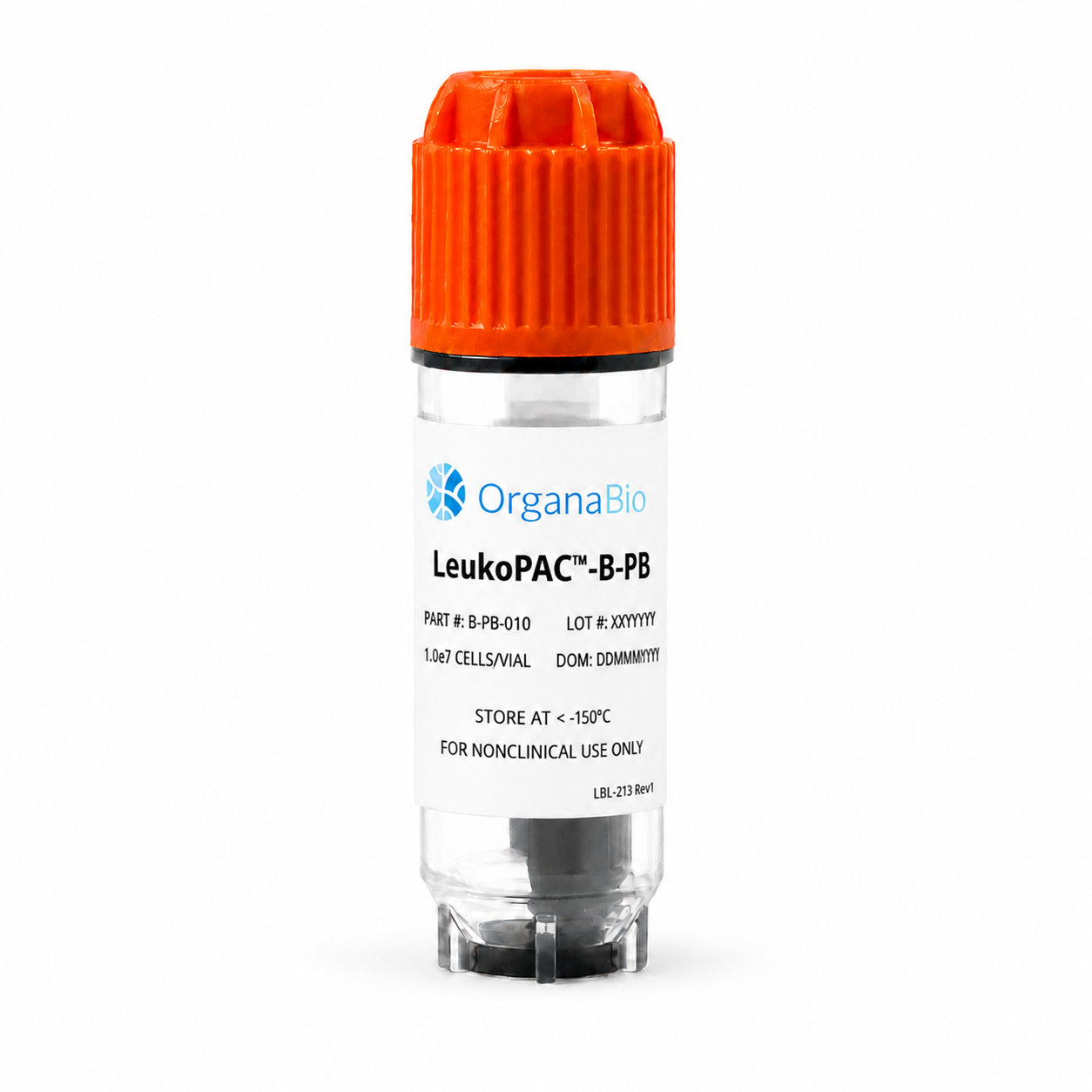 CD19+ B cells, untouchedLeukoPAC-B-PB. Cryopreserved, isolated by negative selection from one adult donor, so nothing has been bound to the B cell surface.
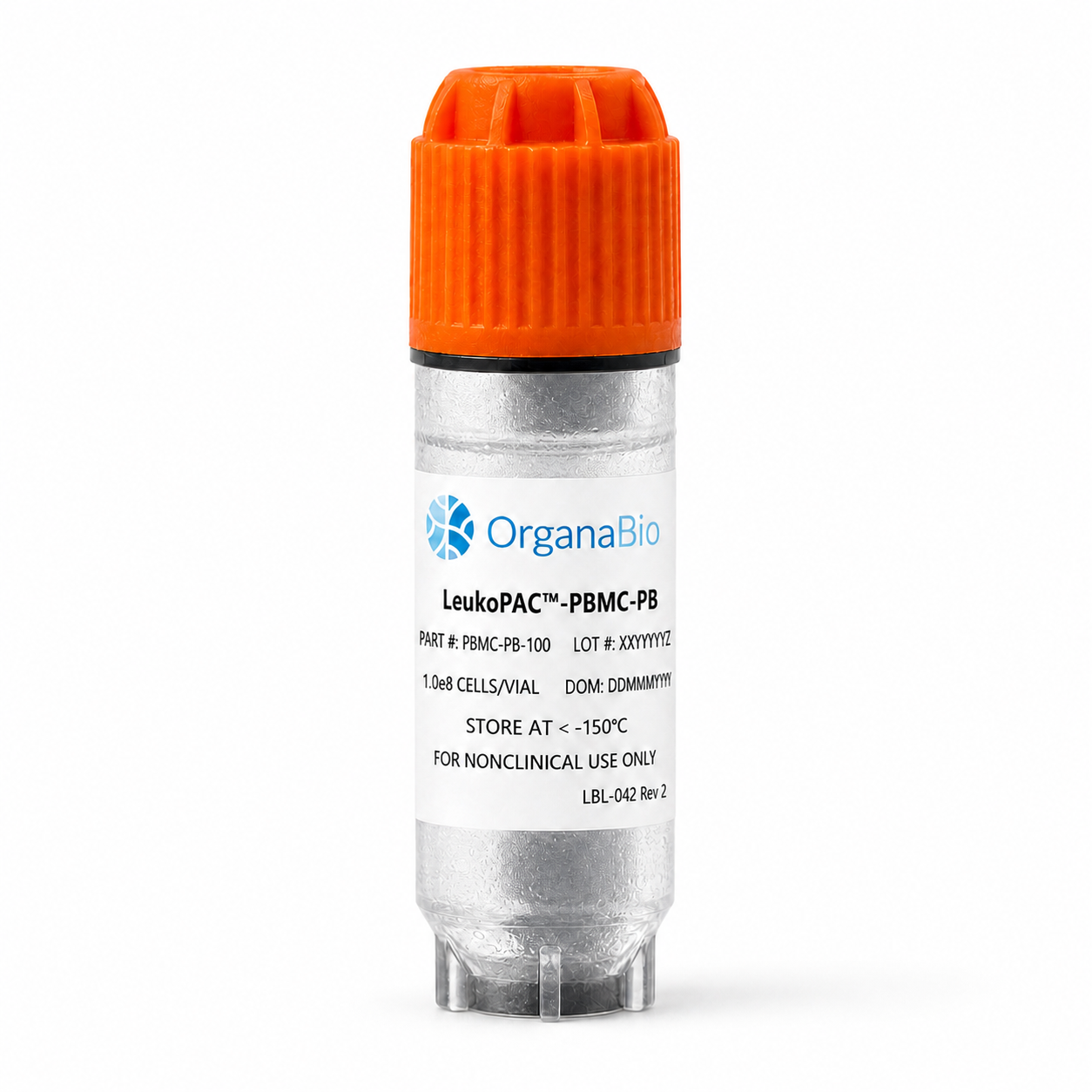 PBMCs, if you want to run your own selectionThe mixed mononuclear fraction B cells are pulled from. Choose this when the isolation method has to be yours.
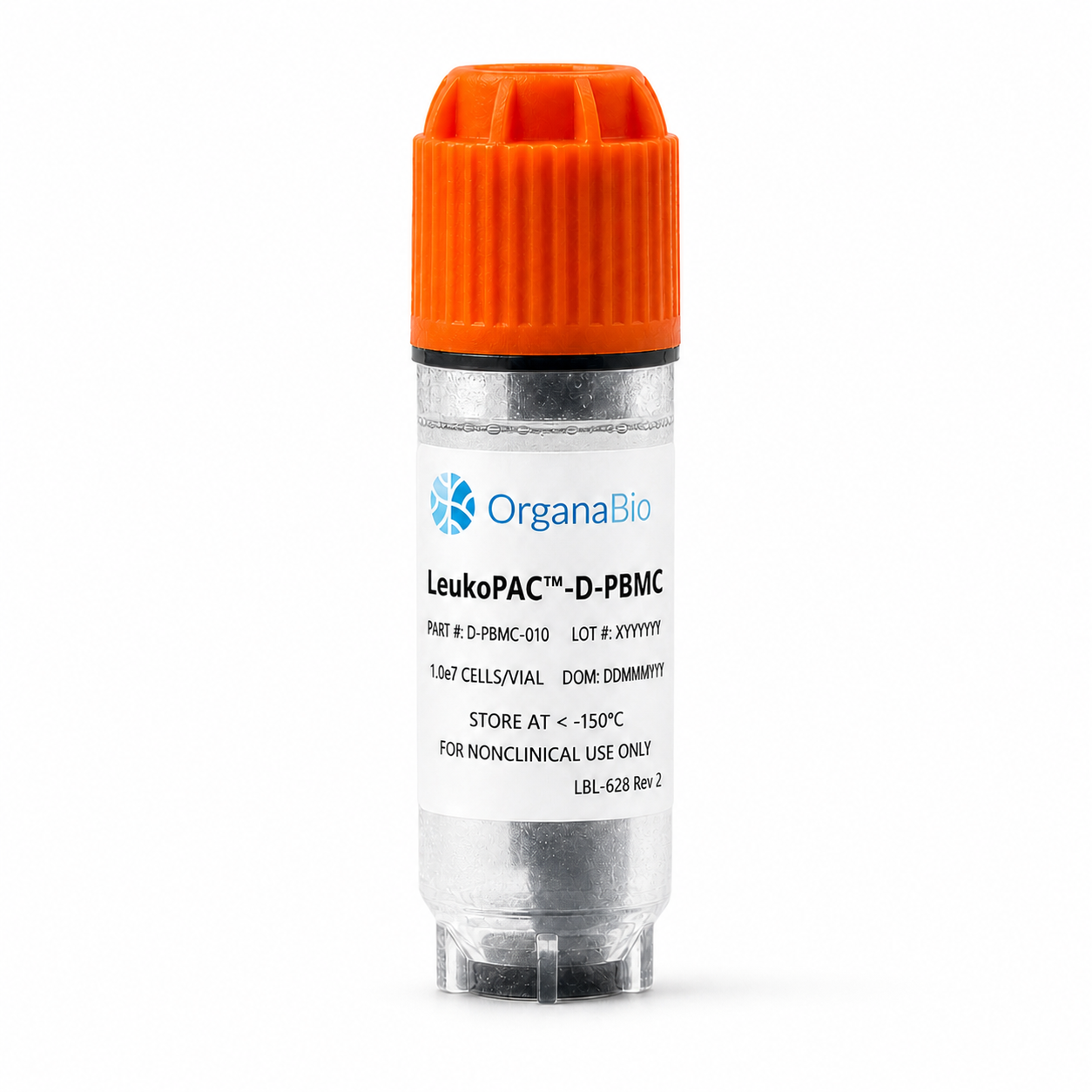 PBMCs from donors with the diseaseFor B-cell autoimmunity work where healthy controls are not the point. Spans 24 autoimmune and inflammatory indications, research use only.
The reason people pick these
What negative selection actually buys you
Positive selection works by binding an antibody to the marker you want and pulling on it. It is fast and it is fine for plenty of applications. But binding anti-CD19 to a B cell crosslinks the receptor, and a crosslinked receptor is a receptor that has already been signalled to. For antibody discovery, activation studies and anything reading BCR biology, you are then measuring a cell that was disturbed before your experiment began.
Negative selection takes the long way around: deplete every cell that is not a B cell, and whatever is left has been touched by nothing. Slower to run, and the reason it is the method on this product.
Specifications
What is published, field by field
| Source | Adult peripheral blood, collected by leukapheresis at OrganaBio. One donor per unit, never pooled. |
|---|---|
| Isolation | Negative selection. Non-B cells are depleted, so no antibody is bound to the B cells themselves. |
| Format | Cryopreserved. Fresh format available on request. |
| Vial sizes | 5 × 10⁶ and 10 × 106 cells per vial. Custom vialing on request. |
| Viability and purity | Measured by flow cytometry and reported on the documentation that ships with each lot. The current product record describes a high-purity B cell population and publishes no numeric threshold, so none is stated here. Ask for recent lot data if a floor matters to your assay. |
| Subsets reported | Naive, memory, transitional and plasmablast frequencies are reported on every lot. |
| HLA typing | High-resolution NGS across HLA-A, B, C, DR, DQ and DP. |
| Donor screening | 14 infectious disease markers under 21 CFR 1271 donor eligibility criteria, plus CMV, EBV and alloantibody status. |
| Documentation | Each lot ships with donor screening, B cell subset frequencies, immunophenotyping by flow cytometry, HLA Class I and II typing, and cryopreservation details. |
| Grade | Research and cGMP grades come from the same donor pool under one quality system, so a programme moving from preclinical to clinical does not requalify donors. |
| Intended use | Preclinical research use only. Not for use in humans. |
Applications
What people order these for
- Antibody discovery
Sequence B cell receptors, generate monoclonals, follow affinity maturation. - Vaccine work
Humoral response, memory B cell formation, antigen-specific activation. - Lymphoma and myeloma
Normal B cell controls for lymphoma, CLL and multiple myeloma programmes. - Autoimmunity
B-cell-mediated autoimmunity, BAFF signalling, autoantibody production. - CAR-T target cells
CD19+ targets for anti-CD19 cytotoxicity and co-culture killing assays. - Subset profiling
Naive, memory, transitional and plasmablast populations, with frequencies on the lot paperwork.
Same donor, more than one product
Matched material beats a matched reference range.
Cells come from a network of over 50,000 donors, and eligible donors can be scheduled for repeat collections. B cells, T cells, monocytes and donor-matched plasma or serum can trace back to one person, which is what a longitudinal design or a matched panel needs and what most catalogues cannot supply.
Buyer questions
B cells, answered
Why negative selection instead of positive?
Positive selection binds an anti-CD19 antibody to the cell surface, which can trigger receptor internalisation and change signalling. Negative selection depletes everything except the B cells, so the surface is left alone. If you are studying the receptor, that difference is the whole experiment.
Why is there no purity percentage on this page?
Because the current product record does not publish one. Purity and viability are measured by flow cytometry and reported per lot, and the scientific team will share recent lot data if your assay needs a floor before you commit. Quoting a threshold that is not on the record would be inventing a guarantee.
Which B cell subsets do I get?
The natural distribution from that donor: naive, memory, transitional and plasmablasts. The frequencies for your specific lot are on the documentation, not estimated from a reference range.
Can I use these as CAR-T target cells?
Yes, that is a common order. They give you CD19+ targets from a characterised human donor rather than a cell line, which matters when the readout is meant to predict behaviour in primary cells.
Can I get B cells and other cell types from the same donor?
Yes. The donor network runs to over 50,000 donors and eligible donors can be scheduled for repeat collections, so B cells, T cells, monocytes and matched plasma or serum can trace back to one person.
Is a cGMP grade available?
Yes, from the same donor pool and the same quality system as the research grade.
Talk to OrganaBio
Tell us what the B cells have to do
Vial size, donor criteria, grade, fresh or cryopreserved, and the assay on the other end. If the readout depends on an undisturbed receptor, say so, because it changes what we would recommend.