


Monocyte-derived macrophages
Macrophages, Differentiated to Your Specification
Macrophages are not something anyone keeps on a shelf. They have to be cultured out of monocytes, and the ones worth having are cultured to a specification: a polarisation state, a cytokine regime, a cell count, a donor. OrganaBio runs that as a service on donor-matched CD14+ monocytes, or sells you the monocytes so you can run it yourself.
ORGANA BIO SOURCE SCOPE
What is published here, and what is not
Everything on this page comes from the current OrganaBio product and donor-program records. Where a record does not publish a numeric threshold, this page does not invent one: it says what is measured and reported instead. Donor criteria, grade, and format are confirmed per request with the scientific team.
Reviewed August 3, 2026 against the current product records.
Two honest routes
Buy the starting material, or have the run done for you
Most labs doing macrophage work order CD14+ monocytes and culture them in house. That is the catalogue route and it is often the right one. The service route exists for programmes where the culture step is not where the team wants to spend its time, or where the macrophages have to sit on the same donor as everything else in the study.
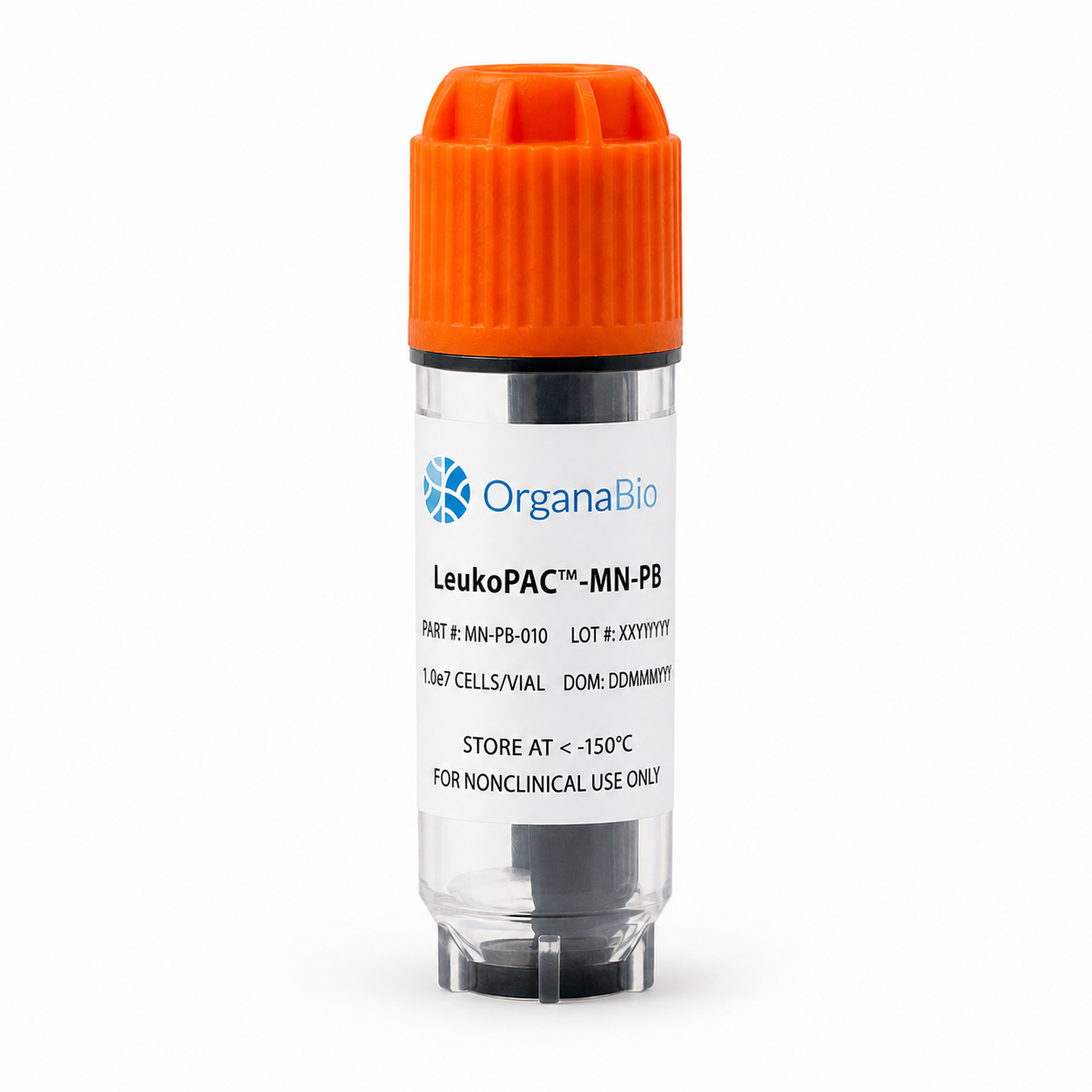 CD14+ monocytes, the starting materialLeukoPAC-MN-PB. This is the catalogue product. Order the monocytes and run the differentiation on your own protocol, in your own hands.
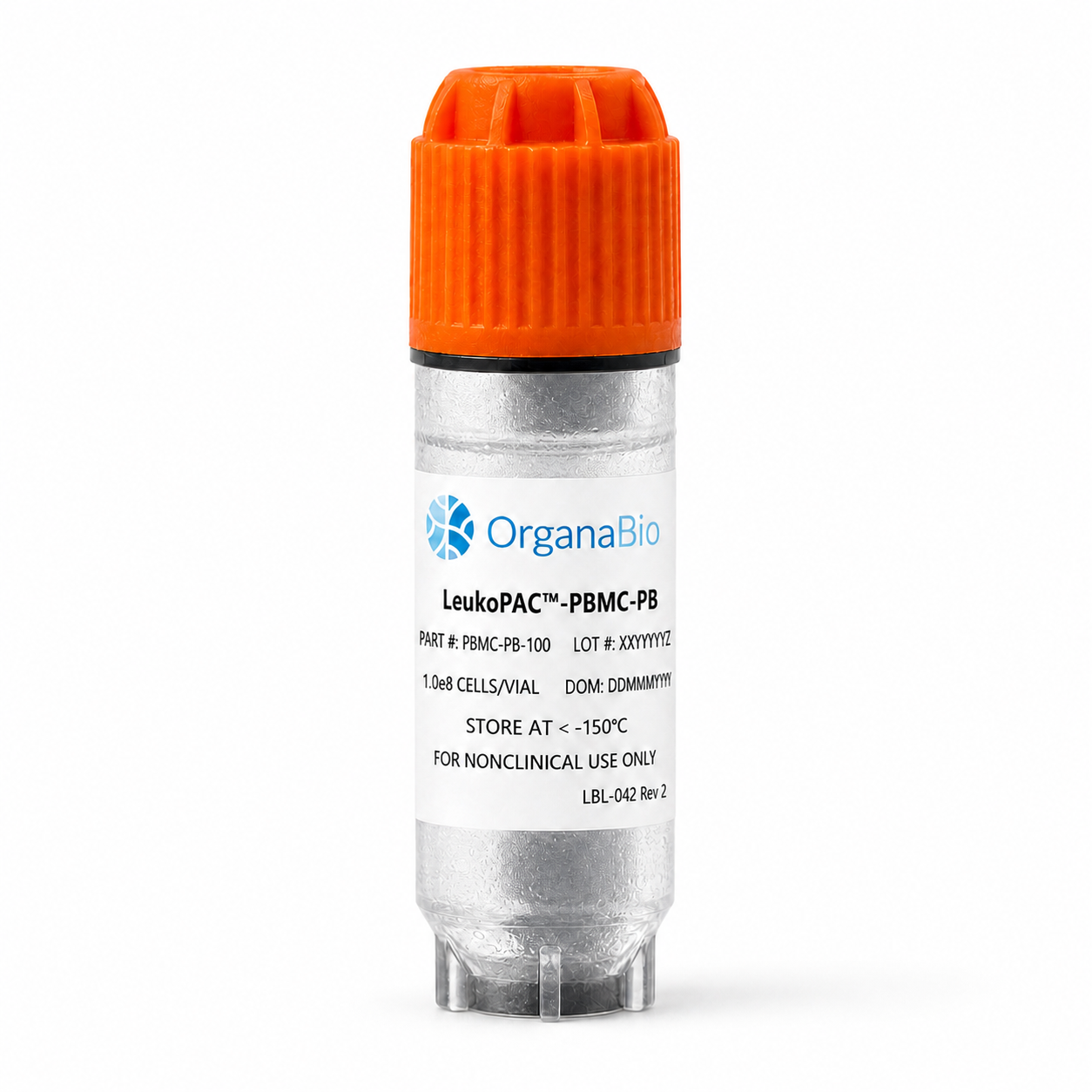 PBMCs, one step further backIf you want to do the CD14 selection as well as the culture.Differentiation run as a serviceWe culture and polarise to your specification and ship the macrophages. Built per programme rather than stocked, so it starts with a conversation about the protocol.
Polarisation
M1 and M2 are different experiments, not different labels
M1, classically activated
- GM-CSF with IFN-γ and LPS
- TNF-α, IL-6 and IL-12 secretion
- Strong phagocytic and microbicidal activity
- CD80+, CD86+, HLA-DR high
- Used in anti-tumour immunity and infection models
M2, alternatively activated
- M-CSF with IL-4 or IL-13
- IL-10 and TGF-β secretion
- Tissue repair and wound healing function
- CD163+, CD206+, CD200R+
- Used in tumour microenvironment and fibrosis work
M0 is the unpolarised state, for labs that want to apply their own polarisation protocol to cells that have already been through the seven-day differentiation.
The run
From collection to your bench
- Donor collection
IRB-consented healthy adult, peripheral blood, processed on site the same day it is collected. - CD14+ isolation
Immunomagnetic enrichment from the leukopak, characterised by flow cytometry. - Seven-day differentiation
M-CSF or GM-CSF culture, with M1 or M2 polarisation applied in the final 48 hours if you have specified one. - Characterisation and ship
Flow cytometry on CD68 and the polarisation markers, then cryopreserved and shipped, or fresh where the schedule allows.
Specifications
What is published, field by field
| What this is | A custom differentiation service, not a stocked catalogue item. Macrophages are made to a programme’s specification from donor-matched CD14+ monocytes. |
|---|---|
| Starting material | CD14+ monocytes enriched from an adult peripheral blood leukopak collected at OrganaBio. One donor per run, never pooled. |
| Differentiation | Seven days in M-CSF or GM-CSF to M0. |
| Polarisation | M0 unpolarised, M1 with IFN-γ and LPS, or M2 with IL-4 or IL-13, applied in the final 48 hours. |
| Characterisation | Flow cytometry on CD68, CD163, CD206, CD80, CD86 and HLA-DR to confirm the polarisation state, reported per run. |
| Viability and purity | Measured and reported for the run. No numeric threshold is published, because output depends on the donor, the cytokine regime and the polarisation state requested. Ask for data from comparable runs before committing a study to it. |
| Format | Cryopreserved and shipped on dry ice, or fresh where the schedule allows. |
| Donor screening | 14 infectious disease markers under 21 CFR 1271 donor eligibility criteria, plus CMV, EBV and alloantibody status. |
| HLA typing | High-resolution NGS across HLA-A, B, C, DR, DQ and DP on the source donor. |
| Donor matching | Monocytes, macrophages and other cell types can come from the same donor, which is the point of running it here rather than buying monocytes from one supplier and culturing them yourself. |
| Intended use | Preclinical research use only. Not for use in humans. |
Applications
What people commission these for
- Phagocytosis assays
Bead-based and pathogen uptake, where the polarisation state changes the answer. - Tumour immunology
TAM biology, ADCP, checkpoint interactions, macrophage-mediated killing. - Drug screening
Anti-inflammatory compounds and checkpoint inhibitors against a defined M1 or M2 state. - Inflammation models
Cytokine production, NF-kB signalling, inflammasome activation. - Infectious disease
Macrophage-pathogen interaction and intracellular killing. - Secretome work
Secretome, exosome cargo and surface marker profiling.
Connected services
The culture step is rarely the only thing a programme needs.
Differentiation sits alongside assay development, process development, clinical cell processing and cGMP manufacturing, on the same donor material and under one quality system.
Buyer questions
Macrophages, answered
Can I just order macrophages from a catalogue page?
Not as a stocked item. Macrophages have to be cultured, and the useful ones are cultured to a specification: which polarisation state, which cytokine regime, how many cells, from what donor. So it runs as a service built per programme. What is stocked is the starting material, CD14+ monocytes, and plenty of labs order those and run the differentiation themselves.
Why would I have OrganaBio do the differentiation instead of doing it in house?
Two reasons people give. It removes seven to ten days of culture plus the optimisation that comes before it, and it puts the macrophages on the same donor as the rest of the material in the study. If neither of those is worth anything to you, order the monocytes and keep the culture in your own hands.
M0, M1 or M2, which do I need?
M0 is unpolarised, for labs that want to apply their own protocol. M1 is the pro-inflammatory state, used in anti-tumour and infection work. M2 is the anti-inflammatory state, used for tumour microenvironment and fibrosis models. If the study compares states, most designs need more than one arm from the same donor.
What phenotype data comes back?
Flow cytometry on CD68 plus the polarisation markers, CD163 and CD206 for M2, CD80, CD86 and HLA-DR for M1, reported for the run rather than quoted from a reference range.
Can the macrophages be donor-matched to other cells in my study?
Yes, and it is the main reason to run it here. The monocytes come from the OrganaBio donor network of over 50,000 donors, and eligible donors can be scheduled for repeat collections, so macrophages, T cells, PBMCs and matched plasma or serum can all trace back to one person.
How long does a run take?
The differentiation itself is seven days, with polarisation in the last 48 hours. The schedule around it depends on donor availability and the criteria you set, so the scientific team will give you a real date rather than a standard lead time.
Talk to OrganaBio
Describe the assay, not the product name
Which polarisation state, how many cells, what the readout is, whether it has to be donor-matched to other material, and when you need it. The scientific team will tell you whether a differentiation run makes sense or whether you should just take the monocytes and do it yourself.