


LEUKOPAKS · ORGANA BIO
Leukopaks for Cell Therapy and Immune-Cell Research
Fresh and cryopreserved single-donor leukopaks from adult peripheral blood, with derived PBMC and immune-cell products for research, process development, and clinical-stage cell-therapy programs.
ORGANA BIO SOURCE SCOPE
Read each metric with its qualifier
This page uses current OrganaBio product, donor-program, and service information. Where the source record identifies a value as an average, minimum, program metric, or subject to availability, that qualification stays with the claim.
Last reviewed July 20, 2026. Product-specific lot values, availability, grade, documentation, and intended use must be confirmed with the scientific team.
Definition
What is a leukopak?
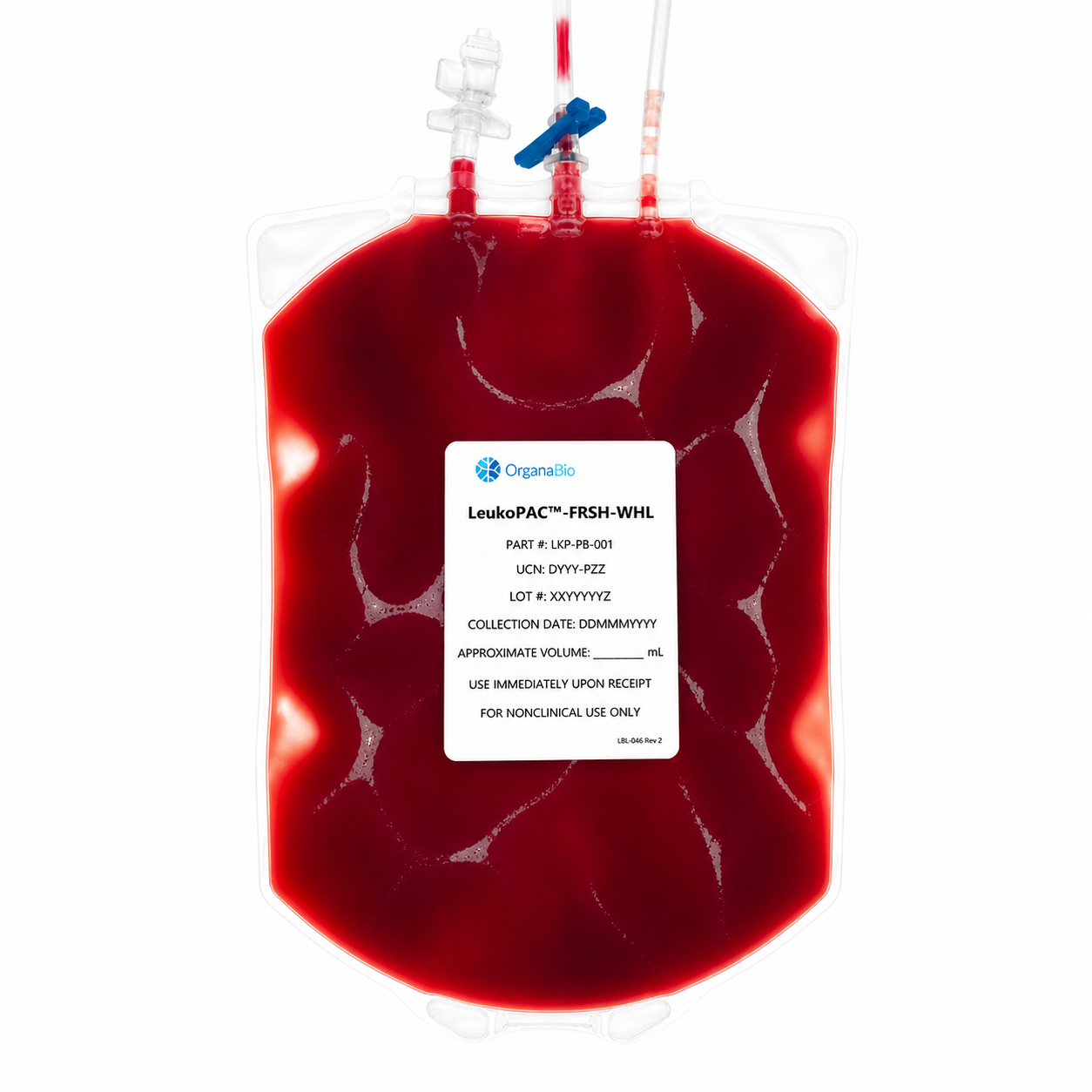
A leukopak is a concentrated, single-donor collection of peripheral blood leukocytes produced by leukapheresis. Blood is drawn from a donor, passed through an apheresis instrument that separates out the white cell layer, and the remaining red cells and plasma are returned to the donor in the same sitting. What comes out is a small-volume, cell-dense unit containing T cells, B cells, NK cells, monocytes and other leukocytes from one person.
The reason it exists is arithmetic. Isolating a useful number of immune cells from ordinary whole blood draws means processing several liters. One leukapheresis session concentrates the same yield into a bag you can process in an afternoon, from a single donor whose characterization you already have on file. For cell therapy development, immune-cell isolation and any workflow where donor-to-donor variability is a variable you are trying to control, that single-donor concentration is the whole point.
OrganaBio collects leukopaks through HemaCenter, its own apheresis subsidiary, from healthy adult donors. Both fresh and cryopreserved formats are documented, in Research Use Only and cGMP grades.
Formats
Types of leukopak, and which one your protocol needs
Fresh
Shipped without cryopreservation for immediate downstream work. Fresh material is the natural choice when the next step is isolation, activation or a functional assay that runs on arrival, and when the schedule can be built around a collection date rather than the other way round.
Cryopreserved
Frozen and held in vapor-phase liquid nitrogen, then thawed on your schedule. Cryopreservation decouples the experiment from the donor calendar, which is what makes repeat-measure designs, multi-site studies and banked comparability work practical.
A third category exists in the wider market: mobilized leukopaks, collected after a donor receives an agent that pushes hematopoietic stem cells out of the marrow and into circulation, which raises the CD34+ fraction. OrganaBio’s peripheral-blood leukopak program uses non-mobilized healthy adult donors. Programs that need CD34+ hematopoietic stem cells are directed to the cord blood-derived HematoPAC-HSC-CB product instead.
Cell count and format
How many cells are in a leukopak
OrganaBio’s product register documents a minimum of 10 billion cells per single-donor whole leukopak unit, for both the fresh and the cryopreserved format. Whole, half, quarter and custom formats are documented, so a study that needs a screening quantity is not obliged to buy a full unit.
| Format | Documented in the product register | Typical use |
|---|---|---|
| Whole leukopak | Minimum 10 billion cells, single donor | Process development, CAR-T and CAR-NK workflows, bulk immune-cell isolation |
| Half | Documented format | Mid-scale isolation, assay validation |
| Quarter | Documented format | Screening, method development, donor comparison panels |
| Custom | Scoped with the scientific team | Protocol-specific volumes and donor criteria |
Cell count is a documented minimum per single-donor unit rather than a per-lot guarantee. Lot-specific values, availability and grade should be confirmed with the scientific team before purchase.
The commercial category
One leukopak hub. Complete product paths.
OrganaBio supplies fresh and cryopreserved whole leukopaks, then isolates PBMCs and immune-cell populations from the same adult peripheral-blood starting material. Use this page as the category starting point for whole leukopaks, defined immune-cell products, PBMCs, and disease-state material.
What is consistent across the program?
- Adult peripheral-blood collection through HemaCenter.
- Donor selection can be scoped by HLA genotype and other documented criteria, subject to availability.
- RUO and cGMP formats are documented across the leukopak portfolio.
- Eligible donors can be scheduled for repeat collections when a program requires continuity.
Product paths
Choose the starting material
CD19+ B cellsCryopreserved CD19+ B cells from adult peripheral-blood leukopaks via negative selection.
CD14+ monocytesCryopreserved CD14+ monocytes from adult peripheral-blood leukopaks for macrophage and dendritic-cell studies.
SLE/Lupus PBMCsCryopreserved PBMCs from donors with documented systemic lupus erythematosus.
Disease-state leukopaksCryopreserved whole leukopaks from disease-state donors, currently focused on SLE/Lupus.
Rheumatoid arthritis PBMCsCryopreserved PBMCs from donors with documented rheumatoid arthritis.
Multiple sclerosis PBMCsCryopreserved PBMCs from donors with documented multiple sclerosis.
Type 1 diabetes PBMCsCryopreserved PBMCs from donors with documented type 1 diabetes.
Crohn’s disease PBMCsCryopreserved PBMCs from donors with documented Crohn’s disease.
Ulcerative colitis PBMCsCryopreserved PBMCs from donors with documented ulcerative colitis.
For the downstream catalog of cells derived from leukopaks, see Leukopak-derived cell products.
Donor matchingHLA, KIR, disease-state, and repeat-collection planning through the donor program.Specifications matrixOne source-backed view of product, donor, screening, and format data.
Collection
How the material is collected
Leukapheresis runs a donor’s blood through a separation instrument, draws off the leukocyte fraction and returns the rest. A session takes a few hours and a healthy adult donor can be scheduled for repeat collections, which is what makes donor continuity possible across a program that runs longer than a single experiment.
OrganaBio runs collection through HemaCenter, its own apheresis subsidiary, rather than buying material from third-party collection networks. That matters for two reasons that show up later in a program. The first is that donor selection criteria can be applied at the point of collection, including HLA genotype, age, sex, ethnicity, blood type, CMV and EBV status, BMI, smoking status and disease state, all subject to availability. The second is that eligible donors can be scheduled again. When a program has qualified a donor and needs more of the same starting material eighteen months later, a documented repeat-collection program is the difference between continuing and starting the qualification work over.
Repeat collection is scoped per program. It is not a blanket guarantee for every donor or every product request.
Grade
RUO and cGMP: what actually changes
Buyers often treat grade as a label on the same box. It is not. Moving from Research Use Only to cGMP changes the raw materials, the contracting, the testing, the documentation, the review chain and who is allowed to release the lot.
| Research Use Only | cGMP | |
|---|---|---|
| Input materials | RUO-grade reagents and consumables | GMP-grade equivalents, including more extensively tested selection reagents |
| Contracting | Standard terms | Requires a clinical master services agreement |
| Testing | Core release testing | Additional testing, including sterility |
| Documentation | Standard batch documentation | Extended documentation and signature requirements |
| Review | Standard technical review | Medical Director and Lab Director review |
| Release | Technical release | Quality Assurance release |
One point is worth being precise about, because the market is loose with it. GMP-grade starting material is manufactured for further manufacturing. It is not, by virtue of being GMP, material for direct human administration. What GMP buys you is a quality system your own filing can reference.
OrganaBio documents both grades across the leukopak portfolio, and operates ISO 7 cGMP cleanroom suites in Miami and, following the Excellos acquisition, in San Diego. A program that starts at RUO and later moves to cGMP stays inside the same donor network and the same quality system, which is the part that saves months.
Comparison
Leukopak, buffy coat, or whole blood
These three get used interchangeably in purchasing conversations and they are not interchangeable in the lab. The distinction is how much of the donor you get, and how concentrated it arrives.
| Whole blood | Buffy coat | Leukopak | |
|---|---|---|---|
| How it is produced | Standard venipuncture draw | Centrifugation by-product of a whole blood donation | Dedicated leukapheresis session |
| Leukocyte content | Lowest per unit volume | Intermediate | Highest, concentrated by design |
| Single donor | Yes | Yes | Yes |
| Repeat collection from the same donor | Limited by donation intervals | Limited by donation intervals | Documented repeat-collection program for eligible donors |
| Best suited to | Small-scale assays, serology | Moderate-scale isolation where cost per cell dominates | Cell therapy development, large-scale isolation, donor continuity |
If a protocol needs billions of cells from one characterized person, and needs to go back to that person again, the leukopak is the only one of the three that answers both requirements.
Budgeting
What actually drives leukopak cost
Published list prices are close to meaningless in this category, because the same nominal product varies by an order of magnitude depending on what is attached to it. It is more useful to understand the drivers, then scope a quote against your actual protocol.
- Grade. cGMP carries additional reagent cost, additional testing, extended documentation, and a Quality Assurance release step. It is the single largest multiplier.
- Format and volume. Whole, half and quarter units price differently, and per-cell economics usually improve with size.
- Fresh or cryopreserved. Fresh carries scheduling and courier constraints. Cryopreserved carries cryopreservation and cold-chain storage.
- Donor selection criteria. A leukopak from any eligible healthy donor and a leukopak from a specific HLA genotype with a defined CMV status are different sourcing problems.
- Characterization depth. How much donor data ships with the unit, and how much additional testing is run.
- Continuity. Programs that need the same donor again over time are scoped differently from one-off purchases.
The costly mistake is rarely the unit price. It is qualifying a supplier at RUO, building a process around that material, and then discovering that the cGMP version comes from a different donor pool under a different quality system, which puts comparability work back on your timeline.
Documentation
What ships with the material
Two leukopaks with identical cell counts are not equivalent products if one arrives with a characterized donor and the other arrives with a lot number. OrganaBio’s donor characterization program documents the following as standard.
- Infectious disease screening. A 14-marker screening panel.
- HLA typing. High-resolution NGS genotyping across six genes: HLA-A, HLA-B, HLA-C, HLA-DR, HLA-DQ and HLA-DP.
- KIR genotyping. Included in the donor characterization program, which matters for NK-directed work where receptor genotype changes how a donor behaves.
- Donor selection attributes. Age, sex, ethnicity, blood type, CMV and EBV status, BMI, smoking status and disease state, available as selection criteria subject to availability.
OrganaBio does not publish a viability, recovery or purity threshold for the whole leukopak formats, because the source record does not support one at the whole-unit level. A blank specification is not a hidden guarantee. Where thresholds are documented, as they are for the isolated cryopreserved PBMC product, they appear on that product’s own record.
Cell state
Why the gap between collection and processing shows up in your data
Leukocytes do not wait politely. The interval between collection and the first processing step changes what you receive, and the effect is well described in the literature: granulocyte carryover rises with delay, and the cells that survive have already begun responding to being in a bag rather than a body. Every downstream measurement inherits that starting point, which is one of the quieter reasons two suppliers can ship the same nominal product and produce different assay results.
Most of the market treats this as a logistics problem to be managed with better shipping. OrganaBio treats it as a structural one. Collection through HemaCenter and processing sit inside the same operation, so material is not crossing the country before anyone touches it. The company runs processing capacity in Miami, Irvine, Hayward and, through Excellos Labs, San Diego.
For clinical trial programs where the sample originates at a site rather than in the donor network, this is handled through the cell processing and cryopreservation service line, which documents its own timing metrics. Those are scoped on the starting material and services pages rather than attached to catalog leukopaks.
INDEPENDENT COVERAGE
OrganaBio in the cell-therapy conversation
Recent interviews, partner announcements, and industry coverage discuss the operating questions around donor supply, distributed processing, and cell-therapy manufacturing. These are external sources, not OrganaBio product specifications.
Fresh or cryopreserved?
Match the format to the workflow
| Choose fresh when | The next step is immediate PBMC or immune-cell isolation, assay setup, or fresh starting-material processing. |
|---|---|
| Choose cryopreserved when | The program needs stored units, scheduling flexibility, or experiments organized around thaw availability. |
| Choose PBMCs when | The team wants the mononuclear fraction rather than a whole leukopak and needs the documented PBMC metrics. |
| Choose T or NK cells when | The program needs an isolated immune-cell population for cell therapy, activation, cytotoxicity, or immune profiling work. |
Connected capabilities
Collection, isolation, processing, and manufacturing in one OrganaBio pathway.
Leukopak products connect to OrganaBio’s clinical cell-processing, donor-matching, analytical, process-development, and cGMP manufacturing capabilities.
Continue to the service layer
Buyer questions
Leukopak questions, answered
How many cells are in an OrganaBio leukopak?
OrganaBio’s product register documents a minimum of 10 billion cells per single-donor whole leukopak unit.
Does OrganaBio offer fresh and cryopreserved leukopaks?
Yes. OrganaBio documents both fresh LeukoPAC-FRSH and cryopreserved LeukoPAC-FRZN formats, with RUO and cGMP options documented across the portfolio.
What donor information can be considered?
The donor program documents HLA genotype, age, sex, ethnicity, blood type, CMV/EBV status, BMI, smoking status, and disease state as selection criteria, subject to availability.
Are the same donors available again?
OrganaBio documents a repeat-collection program for eligible donors. Repeat collection is not a blanket guarantee for every donor or every product request and should be scoped with the scientific team.
What is a leukopak used for?
Leukopaks are used as starting material for cell therapy development including CAR-T and CAR-NK programs, for isolating PBMCs and specific immune-cell populations, for process development and comparability work, and for immunology research and functional assays that need large numbers of cells from a single characterized donor.
Is a leukopak the same as a buffy coat?
No. A buffy coat is the leukocyte layer recovered by centrifuging a standard whole blood donation. A leukopak is produced by a dedicated leukapheresis session, which concentrates substantially more leukocytes into a smaller volume from one donor and allows that donor to be scheduled for repeat collections.
What is GMP compliance for a leukopak?
Moving a leukopak from Research Use Only to cGMP changes the input materials, requires a clinical master services agreement, adds testing including sterility, extends documentation and signature requirements, adds Medical Director and Lab Director review, and requires Quality Assurance rather than technical release. GMP starting material is manufactured for further manufacturing and is not, by virtue of being GMP, material for direct human administration.
Does OrganaBio supply mobilized leukopaks?
OrganaBio’s peripheral-blood leukopak program uses non-mobilized healthy adult donors. Programs that need CD34+ hematopoietic stem cells are directed to the cord blood-derived HematoPAC-HSC-CB product.
Can leukopaks be customized?
Yes. Whole, half, quarter and custom formats are documented, and donor selection can be scoped by HLA genotype and other documented criteria, subject to availability. Custom scoping is handled with the scientific team.
What drives the price of a leukopak?
The main drivers are grade, since cGMP adds reagent cost, testing, documentation and a Quality Assurance release step; format and volume; whether the material is fresh or cryopreserved; how specific the donor selection criteria are; how much characterization ships with the unit; and whether the program needs repeat collections from the same donor over time.
How is a leukopak stored and shipped?
Cryopreserved leukopaks are documented for vapor-phase liquid-nitrogen storage. Fresh leukopaks are shipped for immediate downstream processing and are scheduled around the collection date.
What documentation comes with an OrganaBio leukopak?
The donor characterization program documents a 14-marker infectious disease screening panel, high-resolution NGS HLA genotyping across HLA-A, HLA-B, HLA-C, HLA-DR, HLA-DQ and HLA-DP, and KIR genotyping. Donor attributes including age, sex, ethnicity, blood type, CMV and EBV status, BMI, smoking status and disease state are available as selection criteria subject to availability.
Need the right format for a specific study?
Send the cell type, fresh or cryopreserved preference, grade, donor criteria, and planned use. The OrganaBio team can respond with the product path that fits the request.