


CD14+ monocytes
Monocytes from Human Peripheral Blood
Monocytes are the white blood cells that turn into macrophages and dendritic cells once you put them in culture. Buying them already separated means you start the differentiation on day one instead of spending a day at the bench pulling them out of a leukopak first.
ORGANA BIO SOURCE SCOPE
What is published here, and what is not
Everything on this page comes from the current OrganaBio product and donor-program records. Where a record does not publish a numeric threshold, this page does not invent one: it says what is measured and reported instead. Donor criteria, grade, and format are confirmed per request with the scientific team.
Reviewed August 3, 2026 against the current product records.
Where to start
Buy them separated, or separate them yourself
Three ways to get monocytes out of OrganaBio material. Which one is right depends on whether your protocol needs the isolation step to be yours.
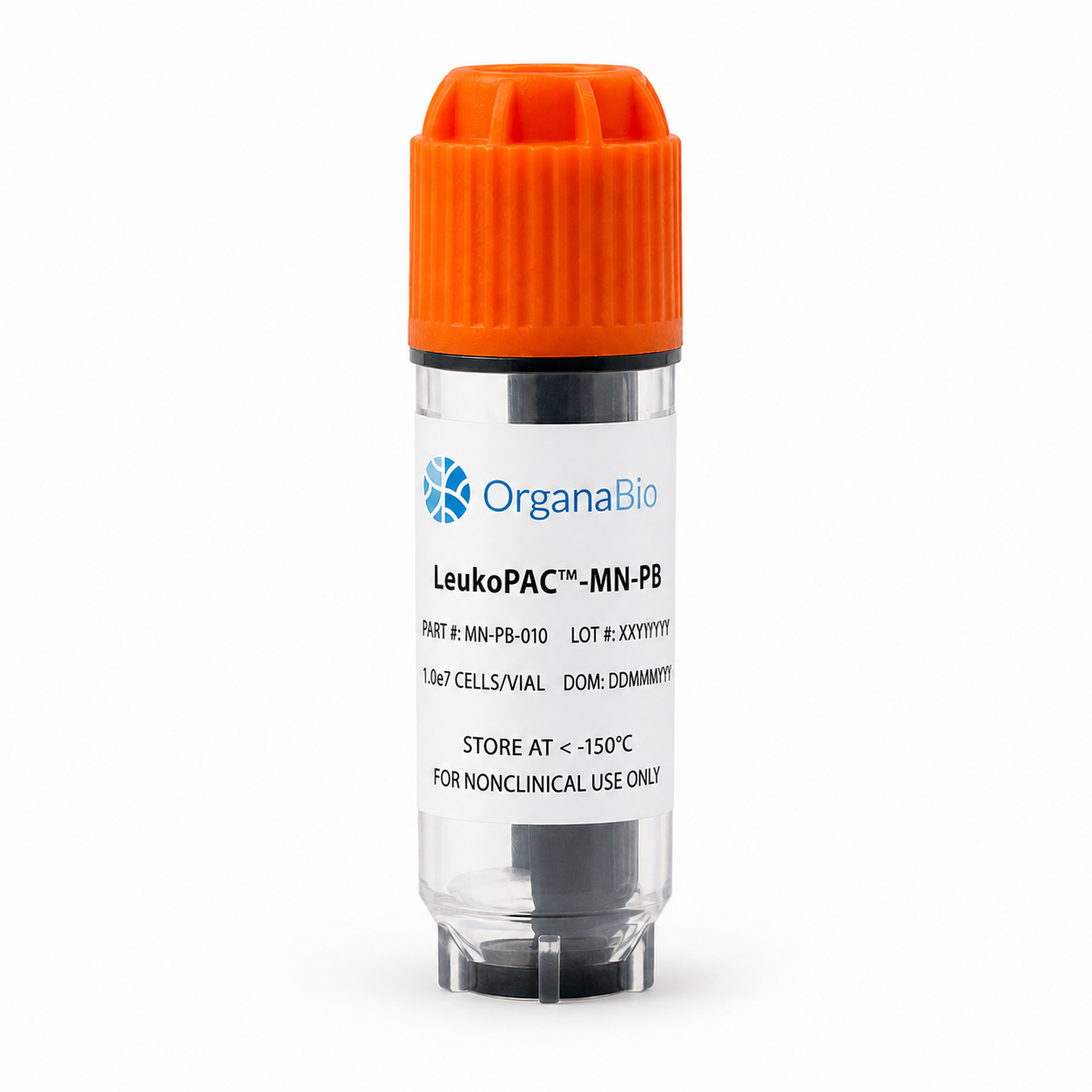 CD14+ monocytes, already separatedLeukoPAC-MN-PB. Cryopreserved, enriched on CD14, from one adult donor. Thaw and start the differentiation the same day.
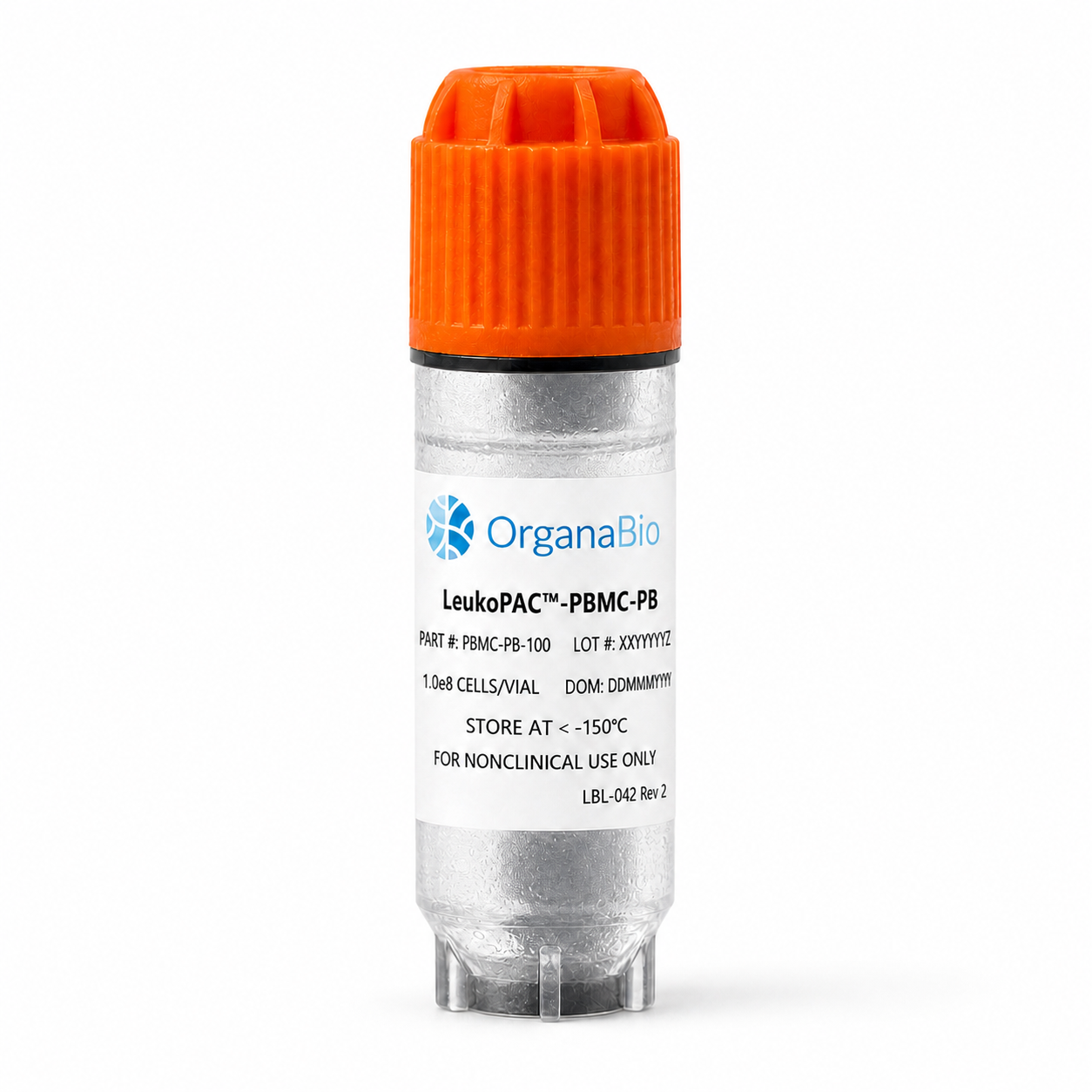 PBMCs, if you would rather isolate them yourselfThe mixed mononuclear fraction that monocytes are pulled from. Choose this if your protocol depends on your own isolation step.
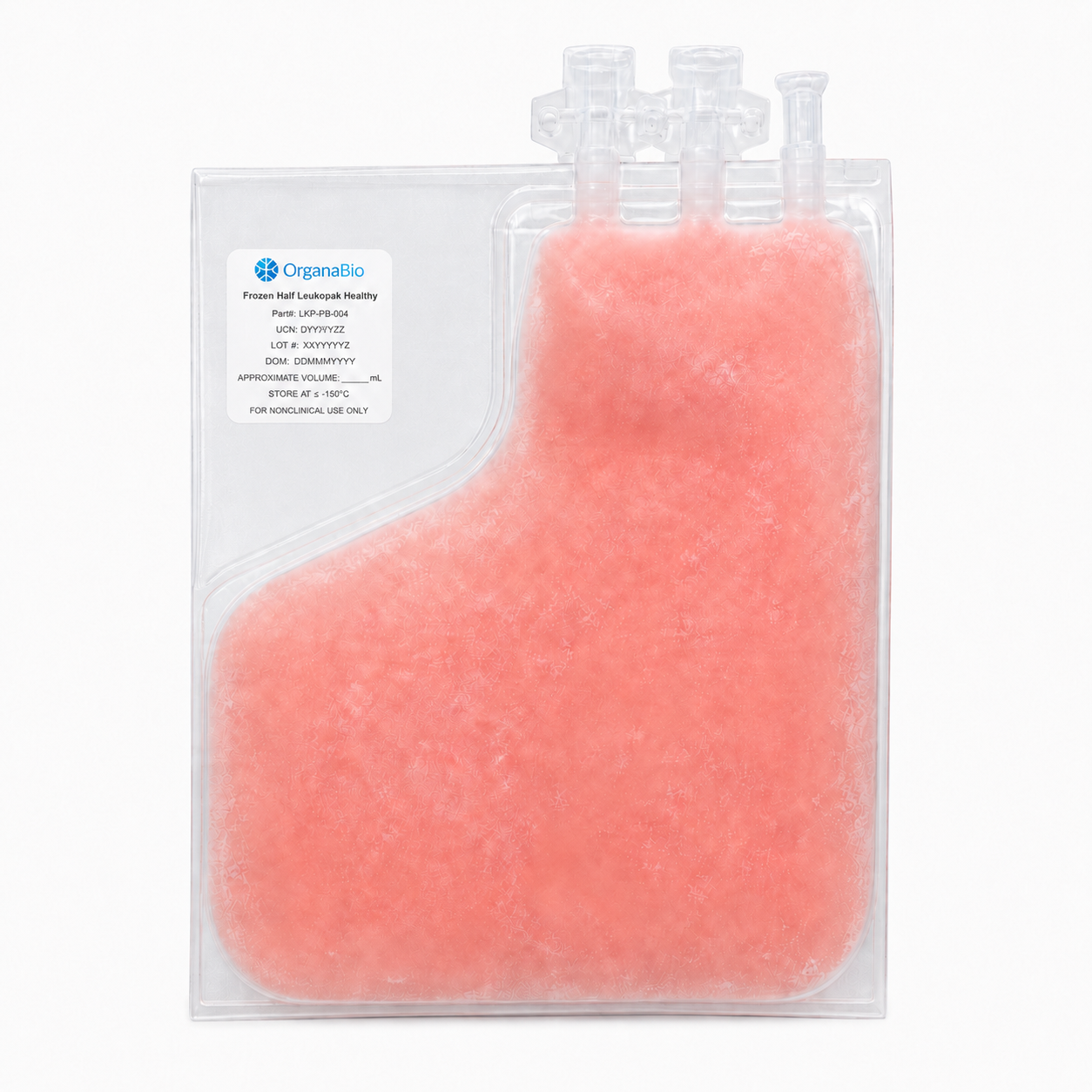 The whole leukopakThe unseparated bag of white cells. Most volume per order, and you decide what to take out of it.
Specifications
What is published, field by field
| Source | Adult peripheral blood, collected by leukapheresis at OrganaBio. One donor per unit, never pooled. |
|---|---|
| Isolation | CD14+ immunomagnetic enrichment from the leukopak. |
| Format | Cryopreserved. Fresh format available on request. |
| Vial sizes | 5 × 10⁶, 10 × 106 and 25 × 106 cells per vial. Custom vialing on request. |
| Viability and purity | Measured by flow cytometry and reported on the documentation that ships with each lot. The current product record describes a high-purity monocyte population and publishes no numeric threshold, so none is stated here. Ask for recent lot data if a floor matters to your protocol. |
| Immunophenotyping | Flow cytometry included with every lot. |
| HLA typing | High-resolution NGS across HLA-A, B, C, DR, DQ and DP. |
| Donor screening | 14 infectious disease markers under 21 CFR 1271 donor eligibility criteria, plus CMV, EBV and alloantibody status. |
| Documentation | Each lot ships with donor screening, immunophenotyping, HLA Class I and II typing, and cryopreservation details. |
| Grade | Research and cGMP grades come from the same donor pool under one quality system, so a programme moving from preclinical to clinical does not requalify donors. |
| Intended use | Preclinical research use only. Not for use in humans. |
Applications
What people order these for
- Macrophage differentiation
M-CSF or GM-CSF culture to M0, then polarise to M1 or M2 on your own protocol. - Dendritic cell generation
GM-CSF plus IL-4 for immature and mature DCs in vaccine and antigen-presentation work. - Innate immunity
Phagocytosis, cytokine release, toll-like receptor signalling. - Drug screening
Compounds aimed at monocyte and macrophage biology in inflammation and oncology models. - Cancer immunology
Tumour-associated macrophage biology, checkpoint interactions, myeloid suppressor cells. - Biomarker work
Surface marker, secretome and transcriptome profiling.
Same donor, more than one product
The donor programme is the part most catalogues cannot match.
Cells come from a network of over 50,000 donors, and eligible donors can be scheduled for repeat collections. That is what makes a longitudinal study or a matched donor panel possible: the same person, months apart, across more than one cell type. Donor-matched plasma and serum can come from the same collection.
Buyer questions
Monocytes, answered
How are the monocytes isolated?
From a peripheral blood leukopak by CD14+ immunomagnetic enrichment. Positive selection on CD14 gives you a monocyte population ready for culture.
Why is there no purity percentage on this page?
Because the current product record does not publish one. A single number across a heterogeneous starting material would not carry weight, and quoting a threshold we do not guarantee would be worse than quoting nothing. Purity and viability are measured by flow cytometry and reported per lot, and the scientific team will share recent lot data if your protocol needs a floor before you order.
Will these differentiate into macrophages and dendritic cells?
Yes. That is the most common reason people order them. M-CSF or GM-CSF for macrophages, GM-CSF plus IL-4 for dendritic cells.
Can I request a specific donor, or the same donor twice?
Yes. The donor network runs to over 50,000 donors and eligible donors can be scheduled for repeat collections, which is what makes longitudinal work and matched donor panels possible. Specify age, sex, ethnicity, blood type, HLA type or CMV and EBV status.
Is a cGMP grade available?
Yes, from the same donor pool and the same quality system as the research grade.
What arrives with the order?
The cells, plus documentation covering donor screening, immunophenotyping by flow cytometry, HLA Class I and II typing, and the cryopreservation details.
Talk to OrganaBio
Tell us what the monocytes have to do
Vial size, donor criteria, grade, fresh or cryopreserved, and when you need it. If a differentiation protocol is driving the requirements, say so and the scientific team will tell you whether monocytes or a custom isolation is the better route.