

GMP Cell Therapy Starting Material for CAR-T: Donor Selection, Apheresis Specs, and Supply Chain Requirements
Your CAR-T manufacturing run is only as good as what you put into it on Day 0. Before your vector touches a T cell, before your transduction protocol runs, before your expansion step begins, the quality of your leukopak determines the ceiling of your entire process. CD4:CD8 ratios that are off, memory subsets depleted by poor handling, T cells that arrive pre-activated and partially exhausted: these problems don’t get fixed downstream. They get amplified. Understanding what to require from your starting material supplier, and how to evaluate whether they can actually deliver it, is one of the highest-leverage decisions in your early-phase manufacturing program.
Why Starting Material Quality Determines CAR-T Manufacturing Outcome
CAR-T cell therapy begins with a leukapheresis product, and the cellular composition of that product shapes every downstream metric that matters: transduction efficiency, expansion potential, memory phenotype of the final product, and ultimately in vivo persistence.
Research published in PMC4277394 identified T cell subset composition as a key determinant of CAR-T product quality and clinical outcome. The CD4:CD8 ratio in the starting material influences the ratio in the final product, and studies have linked specific ratios to improved expansion and function. Memory T cell subsets, particularly stem cell memory (Tscm) and central memory (Tcm), are associated with better persistence and response durability compared to terminally differentiated effector cells (Temra). Starting material with a high proportion of late-stage effector T cells will yield a product with limited proliferative capacity, regardless of how well the manufacturing process runs.
Activation status at collection matters too. T cells that are pre-activated going into your manufacturing process, whether from systemic inflammation in the donor or from suboptimal processing, can accelerate exhaustion during expansion. You want naïve and memory subsets that haven’t yet committed to a terminal effector fate. The window between healthy leukopak collection and the first manufacturing step is where that phenotype is either preserved or lost, which is why processing speed from your supplier is a functional specification, not just a logistics preference.
Granulocyte contamination in the leukopak is another variable that directly affects PBMC yield. Leukopaks with greater than 3% granulocyte content or greater than 3% hematocrit can complicate your PBMC isolation step and reduce yield. These are real product specifications to require in your documentation.
Donor Qualification Requirements for GMP Leukopak Sourcing
Not every donor who walks into an apheresis center is appropriate for GMP cell therapy starting material. The qualification framework separates donors who can supply healthy, phenotypically appropriate T cells from those who cannot, and it has to be executed before collection, not discovered in the documentation after the fact.
Infectious disease marker testing is the baseline. Donors must be screened for HIV-1/2, HCV, HBV, HTLV-I/II, syphilis, and West Nile Virus at minimum, following the mandated infectious disease testing requirements for source plasma and cellular products used in manufacturing. This testing must be performed at a licensed laboratory using validated assays, and documentation must be included with the product.
Health screening beyond infectious disease covers general fitness for apheresis: adequate vein access, hemoglobin and hematocrit within normal ranges, platelet count, blood pressure, and absence of active illness or immunosuppressive medications. Donors on chronic NSAIDs, corticosteroids, or recent immunomodulatory therapies may have altered T cell subset distributions that make them inappropriate for your use case.
HLA typing is increasingly relevant for allogeneic programs and for programs building a matched donor registry. High-resolution HLA typing at six loci (HLA-A, -B, -C, -DRB1, -DQB1, -DPB1) gives your team the data to identify specific donors when a matched product is required. KIR genotyping adds another layer of characterization for NK-cell-adjacent programs. OrganaBio offers HLA typing and KIR genotyping as part of its donor characterization service, so this data ships with your product rather than requiring a separate order.
CMV serostatus matters for certain programs. CMV-seropositive donors carry CMV-specific T cells in their peripheral blood, which can be an advantage or a disadvantage depending on your program design. Your supplier should be able to identify CMV-negative donors from their pool on request.
For IND studies, donor recallability is not a nice-to-have. The regulator may require traceability back to the original donor if a safety signal emerges. Your supplier needs a registry-based donor management system that can recall specific donors, not just a pool of anonymous apheresis appointments.
Apheresis Specifications: Leukopak Collection and Product Specs
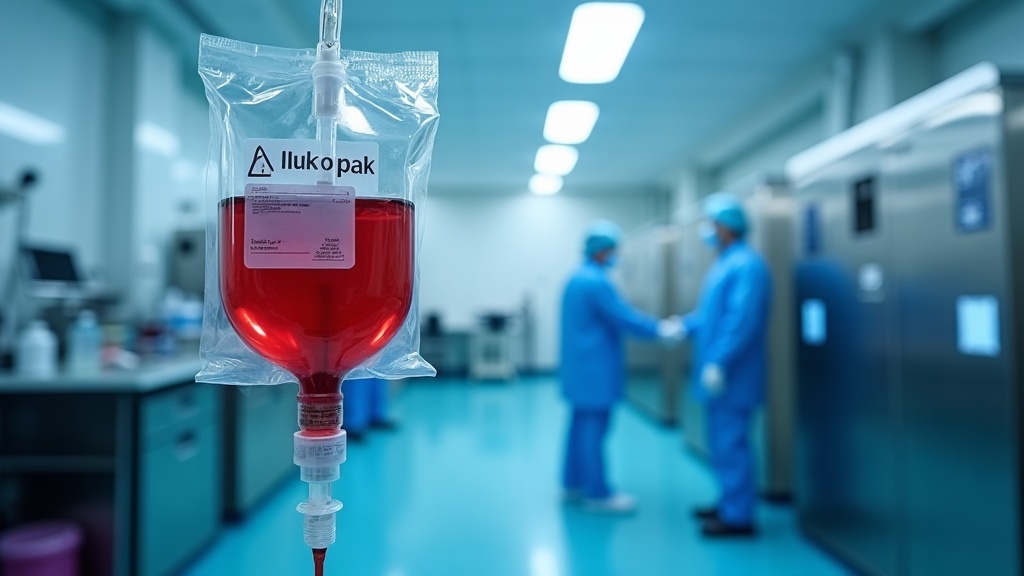
A leukopak is an apheresis product enriched for white blood cells, typically collected over two to three hours using a continuous flow apheresis device. The collection process concentrates peripheral blood mononuclear cells (PBMCs), including T cells, B cells, NK cells, and monocytes, along with some granulocytes and platelets. What you receive should meet specifications that you define in your quality agreement before the first collection.
Key specifications to require in your leukopak documentation:
- Total nucleated cell count (post-collection, pre-processing)
- Viability at time of collection (trypan blue or automated counter)
- Granulocyte content as a percentage of total cells (target: less than 3%)
- Hematocrit (target: less than 3%)
- Volume of the collection product
- CD3+ T cell percentage and absolute count (if immunophenotyping is included)
- Collection date, collection site, and processing timestamps
Volume and total cell count determine how much starting material you actually have for your manufacturing run. A leukopak that meets granulocyte and hematocrit specs but comes in low on total cell count can limit your downstream options, particularly for programs that require multiple product lots from a single donor.
Quarter-split leukopaks are available from some suppliers, including OrganaBio, for programs that need to distribute starting material across multiple sites or reserve aliquots for QC testing, stability studies, or future manufacturing runs. Each quarter-split is cryopreserved separately with its own documentation and chain-of-custody documentation.
Processing speed from collection to first centrifuge spin is a meaningful variable. Delays between blood draw and initial processing allow T cell activation to begin, alter subset distributions, and reduce viability. OrganaBio averages 30 minutes from blood receipt at its facility to first centrifuge spin. This matters in context: many sponsors run their own client-specific processing windows, and getting within that window consistently is what protects your starting material phenotype.
GMP vs. RUO Starting Material: Regulatory Differences and Documentation Requirements
The distinction between GMP-grade and research use only (RUO) starting material is not just a label. It represents a fundamentally different documentation, testing, and quality system infrastructure, and regulators have clear expectations about which grade is appropriate for different stages of product development.
RUO material is appropriate for discovery work, assay development, biomarker research, and early preclinical studies. It is not appropriate for manufacturing a cell therapy product intended for human infusion, even at Phase 1. Using RUO-grade starting material in your IND manufacturing program creates a chain-of-custody problem that the regulator will identify during review.
GMP starting material requires a clinical Master Service Agreement (cMSA) between the sponsor and supplier. Under the cMSA, the supplier commits to specific manufacturing controls, documentation practices, and quality system requirements. The documentation for GMP material carries more documentation than RUO: raw material lot numbers, equipment IDs, in-process testing results, personnel records, deviation logs (if any), and a QA release signature.
Here is what the documentation difference looks like in practice:
| Parameter | RUO Material | GMP Material |
|---|---|---|
| Material grade | Research grade | GMP grade (e.g., GMP-grade separation reagents, beads) |
| Contracting | Standard purchase order | Clinical MSA (cMSA) required |
| Sterility testing | Not required | Required; results documented in documentation |
| Infectious disease testing | Minimal or basic screen | Full required panel, licensed assays |
| HLA typing | Optional | Documented; required for matched programs |
| Batch record | Minimal or absent | Full batch record with deviations documented |
| QA release | Not required | Required; Medical Director and QA sign-off |
| CAPA system | Not required | Required for any non-conformance |
| Facility requirements | Basic lab | ISO 7 cleanroom; environmental monitoring |
| Computer system validation | Not required | 21 CFR Part 11 compliant systems required |
OrganaBio processes GMP cell therapy starting material in ISO 7 cleanrooms at its Miami facility, with IQ/OQ/PQ equipment qualification, process validation, cleaning validation, and a 21 CFR Part 11 compliant quality management system. Every GMP lot goes through QA release before shipping.
One important boundary: disease-state donor material (collected from donors with autoimmune conditions, for example) is RUO only at OrganaBio. It is appropriate for disease modeling, biomarker discovery, and drug screening research, but not for use as GMP manufacturing starting material for patient infusion products. Autologous CAR-T programs requiring starting material from the actual patient use the patient’s own apheresis product, collected through clinical sites under separate arrangements.
Fresh vs. Cryopreserved Leukopaks: Trade-Offs for CAR-T Manufacturing
The choice between fresh and cryopreserved leukopaks has real consequences for your manufacturing schedule, your logistics complexity, and the phenotype of the T cells you receive.
Fresh leukopaks deliver cells with no freeze-thaw cycle, which preserves T cell phenotype most completely and avoids any viability losses associated with cryopreservation and thaw. For programs running tight manufacturing timelines or where T cell activation status at Day 0 is a critical variable, fresh material is often the better option. The constraint is logistics: fresh material has a short window from collection to processing, and your manufacturing site needs to be ready to receive and begin processing on the day of collection. You are also dependent on donor availability aligning with your manufacturing schedule.
Cryopreserved leukopaks eliminate the scheduling dependency. You can receive inventory, store it in your vapor-phase liquid nitrogen system, and begin manufacturing when your process is ready. For programs with unpredictable or flexible timelines, for clinical sites running across multiple manufacturing campaigns, or for programs that want to test multiple manufacturing conditions against the same donor lot, cryopreserved material offers real operational flexibility. The trade-off is that cryopreservation and thaw introduce additional variability, and some programs observe shifts in subset distribution or activation status post-thaw.
PBMC isolation from leukopaks, whether fresh or cryopreserved, yields approximately 85% of the starting PBMC content when performed correctly. OrganaBio uses negative isolation as its default PBMC isolation method, meaning isolation beads bind to non-target cells and are removed, leaving your target T cells, B cells, or NK cells untouched. Positive selection methods, by contrast, bind beads directly to the target cell surface, which can trigger activation signals you do not want going into a CAR-T manufacturing run. Negative selection preserves a non-activated, non-exhausted phenotype, which is the state you want at Day 0.
Isolated subsets (CD3+ T cells, CD4+, CD8+, NK cells, B cells, monocytes) are available as off-the-shelf inventory or as custom orders depending on your program requirements. Purity specifications for isolated T, B, and NK cells are at or above 90%, with post-isolation viability at or above 95%.
Supplier Evaluation Framework: What to Ask Before You Commit
Selecting a leukopak supplier for an IND program is a vendor qualification decision, not a purchase decision. Here is the framework for evaluating whether a supplier can support your program through manufacturing development, IND submission, and into Phase 1.
Processing speed and vertical integration. Ask specifically: does the supplier process leukopaks at their own facility, or do they rely on third-party collection centers for processing? Suppliers who control both the apheresis collection and the processing in the same facility control the chain of custody more completely and can guarantee shorter times from collection to processing. This matters for T cell phenotype on arrival.
documentation structure. Review a sample documentation before committing. A GMP-appropriate documentation for a leukopak or isolated cell product should include: collection date and time, processing timestamps, cell count and viability, granulocyte and hematocrit percentages, infectious disease testing results with assay names, and the QA release signature. If the documentation is missing timestamps, does not include infectious disease results, or lacks a QA sign-off, that is documentation gap that will surface during your IND review.
Chain of custody documentation. Your supplier should be able to provide a continuous, timestamped chain of custody from donor consent through final product shipment. Gaps in that chain are regulatory exposure. Ask for a chain-of-custody document example from a previous lot.
Donor characterization included vs. purchased separately. Some suppliers provide a basic cell count documentation and sell immunophenotyping, HLA typing, and infectious disease testing as add-on services, which adds cost and turnaround time. OrganaBio includes donor HLA typing, infectious disease testing, and immunophenotyping characterization with product, so you receive a fully characterized lot without assembling separate orders.
Recall capability. Ask directly: if we need to recall a specific donor for a second collection six months from now, can you do that? The answer tells you whether they maintain a registered, consent-compliant donor registry or whether they run on one-time appointments. For IND studies and long-term clinical programs, donor recallability is essential.
Facility accreditation. OrganaBio holds AABB accreditation, which establishes standards for blood banking, transfusion medicine, and cellular therapy product collection and processing. AABB accreditation is evidence of an independently audited quality system, not just a self-assessment.
Isolate method: negative vs. positive selection. This is a technical question worth asking any supplier offering isolated subsets. Negative isolation leaves target cells untouched by beads; positive selection attaches beads to the target cell surface. For CAR-T starting material, non-activated, non-bead-touched T cells are the goal.
Supply Chain Risk: Single-Site vs. Multi-Site Suppliers
A leukopak supplier with a single collection and processing location creates a single point of failure for your manufacturing program. Adverse weather events, facility maintenance, staff shortages, or a regulatory hold on that one site can interrupt your supply exactly when you need it for a scheduled manufacturing campaign.
Multi-site suppliers distribute that risk. If one location has a temporary interruption, a second location with the same GMP controls and donor registry can fulfill the order without changing your product specifications or your regulatory documentation. For Phase 1 programs that depend on consistent starting material, supply chain redundancy is a program protection measure, not a procurement luxury.
OrganaBio operates as a bi-coastal CTDMO, with facilities in Miami and San Diego. Both locations maintain the same quality system, the same donor qualification protocols, and the same GMP processing controls. For sponsors running programs that require geographic distribution, or that need supply continuity through any single-site disruption, the dual-coast structure provides real operational insurance.
The definition matters here. OrganaBio is a CTDMO: Contract Testing, Development, and Manufacturing Organization. The “T” for Testing is intentional and reflects the integrated QC, assay development, sterility testing, HLA typing, and infectious disease testing services that run alongside manufacturing. This is different from a CDMO that manufactures but outsources testing, or a CRO that tests but does not manufacture. The integrated model means that testing and manufacturing happen under the same quality system and the same roof, which simplifies your vendor management and your regulatory documentation.
Leukopak Supplier Comparison: Key Specifications to Require
| Specification | Minimum to Require | OrganaBio Spec |
|---|---|---|
| Granulocyte content in leukopak | <5% | <3% |
| Hematocrit in leukopak | <5% | <3% |
| PBMC yield from leukopak | >75% | 85%+ |
| T/B/NK cell purity (isolated subsets) | >85% | >90% |
| Post-isolation viability (isolated subsets) | >90% | >95% |
| Isolation method for subsets | Negative or positive (specify) | Negative isolation (default) |
| Sterility testing included (GMP) | Required | Yes |
| Infectious disease testing panel | required panel, licensed assays | Yes |
| HLA typing included | Preferred for IND programs | Yes, 6-gene high-resolution + KIR |
| QA release signature on documentation | Required for GMP | Yes |
| Donor recallability | Required for IND studies | Yes, registered donor pool |
| AABB accreditation | Strongly preferred | Yes |
| Facility cleanroom class | ISO 7 minimum | ISO 7 |
| Multi-site supply capability | Preferred for Phase 1+ | Yes (Miami + San Diego) |
| Fresh leukopak availability | Preferred for tight manufacturing windows | Yes, processed at OB facility |
| Cryopreserved leukopak availability | Required for flexible scheduling | Yes |
| Quarter-split leukopak option | Useful for multi-campaign programs | Yes |
Frequently Asked Questions
What is the difference between a leukopak and PBMCs for CAR-T manufacturing?
A leukopak is the raw apheresis product: a concentrate of white blood cells including T cells, B cells, NK cells, monocytes, and some granulocytes, collected directly from the donor. PBMCs (peripheral blood mononuclear cells) are a processed fraction of the leukopak, obtained after density gradient centrifugation to remove granulocytes and red blood cells. For CAR-T manufacturing, many programs receive a leukopak and perform their own downstream processing, while others prefer to receive pre-isolated PBMCs or specific T cell subsets depending on their process design and the capabilities of their manufacturing facility.
When does my program need GMP-grade starting material vs. RUO?
Any time you are manufacturing a cell therapy product that will be administered to a human patient, you need GMP-grade starting material. This applies from the first-in-human Phase 1 dose through all subsequent phases. RUO material is appropriate for preclinical work, assay development, feasibility studies, and process development where the cells will not be used in a patient. Using RUO starting material in manufacturing for clinical use creates a regulatory documentation problem that will be identified during regulatory review of your IND application.
How do I evaluate the processing speed of a leukopak supplier?
Ask for data, not a description. A credible supplier can provide summary data showing average time from blood receipt to first processing step across a representative sample of collections. You are looking for a supplier who consistently falls well within any processing window your sponsor or CMO requires. Some manufacturing programs define a specific window (for example, processing must begin within 6 to 8 hours of blood draw) to protect T cell phenotype. Your supplier’s processing time from receipt to first spin should have a meaningful buffer inside that window, not a median that scrapes the limit.
What does negative isolation mean and why does it matter for CAR-T?
Negative isolation means the separation process uses magnetic beads that bind to cells you want to remove, such as monocytes and B cells, rather than to the T cells you want to keep. After the beads are pulled away by a magnet, your target T cells are in the untouched fraction. Positive selection binds beads directly to the surface of T cells (typically via CD3 or CD4/CD8 markers), which can trigger TCR signaling and begin activating the cells before your manufacturing process even starts. For CAR-T programs aiming to transduce and expand naïve or memory T cells, receiving pre-activated cells at Day 0 compresses your manufacturing window and can accelerate exhaustion. Negative isolation preserves the resting state you want.
What documentation should I require from my leukopak supplier for IND filing?
Your IND filing will require documentation of your starting material source and quality. From your supplier, you need the executed clinical MSA (cMSA), the product-specific quality agreement, documentation for each lot with all GMP-required fields (timestamps, QA release, testing results), batch records with deviation logs, supplier qualification documentation confirming their GMP status and facility accreditation, and evidence of their donor consent and infectious disease testing program. Many sponsors request a pre-IND supplier audit as part of vendor qualification. Your supplier should be able to support a site visit and provide documentation packages on request.
Can I use the same donor multiple times across my manufacturing program?
Yes, if your supplier maintains a registered donor pool with recall capability. Donor recallability means the supplier can contact a specific donor identified by a unique registry ID and schedule them for a second or third apheresis collection. This is valuable for programs that want to compare manufacturing lots from the same donor across different batches, for programs that need a known-healthy donor for each new manufacturing campaign, and for IND studies where the regulator may require traceability back to the original donor if a safety signal emerges. Not all leukopak suppliers operate a registry-based model. Some run on one-time donor appointments with no recall capability.
What is AABB accreditation and why does it matter for cell therapy starting material?
AABB (formerly the American Association of Blood Banks) is an international, not-for-profit accreditation organization that develops standards for blood banking, transfusion medicine, and cellular therapy product collection and processing. AABB accreditation means the facility has been audited against those standards by an independent assessor, not just self-assessed. For leukopak suppliers supporting cell therapy programs, AABB accreditation provides evidence that the donor screening, collection, processing, and storage practices meet an established, audited quality standard. Some sponsors require AABB accreditation as a condition of vendor qualification.
What is the difference between a CTDMO and a CDMO for cell therapy starting material?
A CDMO is a Contract Development and Manufacturing Organization, a supplier that handles manufacturing and development services. A CTDMO adds integrated testing services under the same roof and the same quality system. For cell therapy starting material specifically, this means HLA typing, sterility testing, infectious disease testing, QC assay development, and immunophenotyping are part of the same organization as the manufacturing and processing operations. The practical difference for your program: a CTDMO can issue a single documentation with integrated testing results rather than requiring you to coordinate separate orders from a manufacturer and a contract testing lab. OrganaBio operates as a CTDMO, providing donor screening, leukapheresis, PBMC isolation, GMP processing, and testing services under one quality system across its Miami and San Diego facilities.
Ready to Evaluate Your Starting Material Supply Chain
The decisions you make about your leukopak supplier now determine what is possible in your CAR-T manufacturing program months from now. Donor characterization, processing speed, isolation method, GMP documentation, and supply chain redundancy are not procurement details. They are manufacturing variables with direct consequences for your IND timeline and your Phase 1 product quality.
OrganaBio supplies GMP leukopaks and isolated cell products (PBMCs, T cells, NK cells, B cells) from its bi-coastal CTDMO network in Miami and San Diego. Donors are registered and recallable, HLA typing and infectious disease testing ship with the product, and PBMC isolation uses negative selection as the default. Fresh collections are processed at OrganaBio’s own facility, with no third-party collection centers in the processing chain. GMP manufacturing runs in ISO 7 cleanrooms under a 21 CFR Part 11 compliant quality system, with AABB accreditation covering the collection and processing operations.
To discuss your program’s starting material requirements, request a sample documentation, or begin supplier qualification, contact OrganaBio at organabio.com.