

Two Source Tissues, Two Different Development Paths
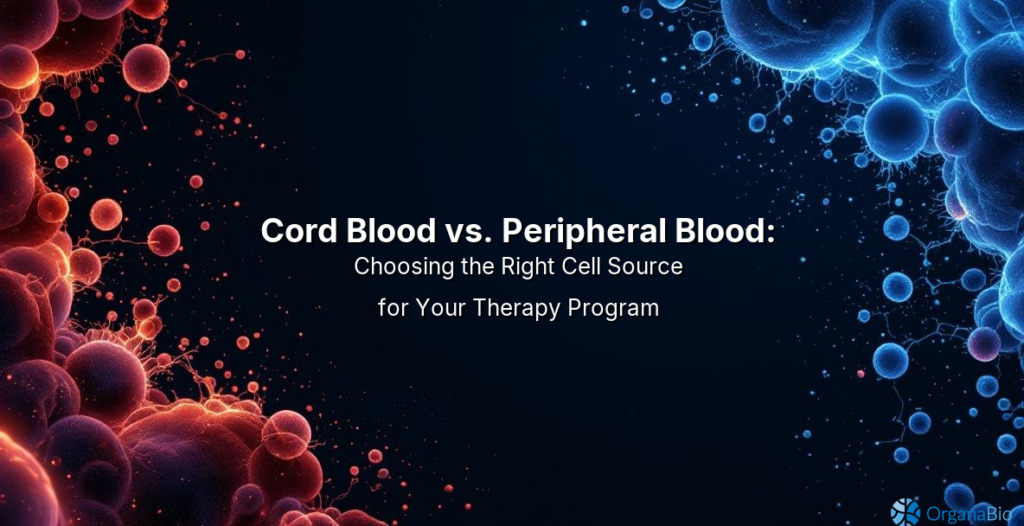
When designing a cell therapy program, one of the earliest and most consequential decisions is the source tissue for your cellular starting material. Cord blood and adult peripheral blood are the two dominant sources, and they lead to fundamentally different product profiles, manufacturing workflows, and regulatory considerations.
This isn’t a question with a universal answer. The right source depends on your therapeutic target, your manufacturing model (autologous vs. allogeneic), your scale requirements, and increasingly, on your competitive positioning in a crowded clinical landscape.
Peripheral Blood: The Established Workhorse
Adult peripheral blood, collected via leukapheresis into a leukopak, remains the most widely used starting material in cell therapy. Every FDA-approved CAR-T product on the market today uses autologous peripheral blood as its source.
The reasons are practical. Peripheral blood donors are abundant and can be collected repeatedly. A single leukapheresis yields billions of cells with a mature, fully differentiated immune cell composition — high proportions of effector T cells, experienced NK cells, and functional monocytes. For autologous therapies, the patient themselves serves as the donor.
OrganaBio provides peripheral blood-derived products across the full processing spectrum: unprocessed fresh and cryopreserved leukopaks, isolated PBMCs, purified CD3⁺ T cells, and sorted CD56⁺ NK cells.
The limitations of peripheral blood are equally practical. Autologous collection requires the patient to undergo leukapheresis — a procedure that’s not feasible for all patient populations, particularly those who are heavily pre-treated, lymphodepleted, or pediatric. Donor-to-donor variability in cell composition and T cell fitness is inherent and must be managed through robust manufacturing processes.
Cord Blood: The Allogeneic Frontier
Cord blood — collected from the umbilical cord and placenta immediately after birth — offers a different cellular profile with distinct therapeutic implications.
The cells are immunologically naïve. They haven’t been shaped by decades of antigen exposure, viral infections, and immune aging. This translates to lower alloreactivity (reduced GvHD risk in allogeneic settings), higher proliferative potential during ex vivo expansion, and a more homogeneous starting population.
For allogeneic therapy developers building off-the-shelf products, these properties are compelling. OrganaBio’s cord blood product line includes unprocessed fresh cord blood units, purified CD34⁺ hematopoietic stem cells, isolated cord blood T cells (ImmunoPAC™-T-CB), and cord blood NK cells (ImmunoPAC™-NK-CB).
Cord blood’s limitations are volumetric and logistical. A single cord blood unit contains far fewer total cells than a peripheral blood leukopak — typically 10-50x fewer nucleated cells. This means expansion is usually mandatory before therapeutic doses can be achieved. Collection is a one-time event tied to childbirth, so you can’t go back to the same donor for additional material.
Head-to-Head: What the Data Shows
The comparison between sources varies by cell type and intended application:
T cells: Peripheral blood T cells are predominantly memory and effector populations with established antigen specificity. Cord blood T cells are overwhelmingly naïve (CD45RA⁺), with high expansion potential but requiring more robust activation protocols. For CAR-T, peripheral blood dominates in autologous settings; cord blood is emerging in allogeneic platforms.
NK cells: Peripheral blood NK cells show higher baseline cytotoxicity. Cord blood NK cells have higher expansion capacity — some published protocols achieve >1000-fold expansion from cord blood NK cells. For off-the-shelf NK cell therapy programs, cord blood’s expansion advantage can outweigh its lower starting cytotoxicity.
HSCs (CD34⁺ cells): Cord blood has been used in hematopoietic stem cell transplantation for decades. The naïve immune system that develops from cord blood HSCs results in lower chronic GvHD rates compared to adult donor transplants, though engraftment can be slower due to lower cell doses.
MSCs: Neither cord blood nor peripheral blood is the primary MSC source — umbilical cord tissue (Wharton’s jelly) and placenta are preferred. OrganaBio’s MesenPAC™-MSC-UC and MesenPAC™-MSC-PL products provide perinatal MSCs from these tissues.
Regulatory and Supply Chain Considerations
Both source tissues require FDA-compliant donor screening under 21 CFR Part 1271. However, the screening logistics differ. For peripheral blood, donors can be pre-screened, qualified, and scheduled for collection based on program needs. For cord blood, screening happens post-collection (maternal screening during pregnancy with confirmatory testing after delivery), and the decision to use a unit depends on screening results that come after the collection has already occurred.
Supply chain predictability also differs. Peripheral blood collections can be scheduled weeks in advance with high reliability. Cord blood collections depend on birth timing and maternal consent, introducing more variability in collection schedules — though a supplier with a large collection network can buffer this variability through inventory banking.
Making the Decision for Your Program
Choose peripheral blood if you’re developing an autologous therapy, need maximum starting cell counts, want the most established regulatory pathway, or are working with mature effector cells.
Choose cord blood if you’re building an allogeneic off-the-shelf platform, need immunologically naïve cells with high expansion potential, want to minimize GvHD risk, or are developing pediatric HSC transplant protocols.
Many programs source both — using peripheral blood for their autologous pipeline and cord blood for their allogeneic pipeline, from the same qualified supplier. OrganaBio provides both tissue sources with consistent quality standards, screening protocols, and documentation, making it straightforward to work across both platforms.
Evaluating source tissue options for your cell therapy program? Contact OrganaBio to discuss your specific requirements with our scientific team.